Showing posts with label WWII. Show all posts

Saturday, 4 January 2020

JOJO RABBIT : Thursday 2nd January 2020.

I finally saw the M Rated 'JOJO RABBIT' earlier this week, and this American satirical black comedy that is a send up of Nazi Germany during WWII is Directed, Co-Produced, Written and starring New Zealand's very own Taika Waititi, whose last film outing was the highly acclaimed 'Thor : Ragnarok' and before that 'The Hunt for the Wilderpeople'. This film is based on Christine Leunens's 2008 novel 'Caging Skies', and had its world Premiere showing at TIFF in early September where it won the top prize, the 'Grolsch People's Choice Award' before its wider release in the US in mid-October and in New Zealand in late October. The film has divided Critics, however, most seem to be praising the performances, the humour, the screenplay and the heart-warming story. Made for US$14M the film has so far grossed US$26M. It has so far picked up nineteen award wins and a further 99 nominations from around the awards and festival circuit, with many of those nominations still awaiting final determination.

Here lonely ten year old German lad Johannes 'Jojo' Betzler (Roman Griffin Davis) is living in Nazi Germany during the late stages of WWII with his mother Rosie (Scarlett Johansson). His father has been missing in action somewhere on the Italian front for the last two years and his older sister Inge died more recently of influenza. Jojo has an imaginary friend that he frequently speaks with, confides in and seeks advice from - a childish version of Adolf Hitler (Taika Waititi).

Jojo and his best friend Yorki (Archie Yates) attend a Hitler Youth training camp for 10-14 year old boys and girls, run by Captain Klenzendorf (Sam Rockwell). When Jojo is ordered to kill a rabbit to prove himself by more senior ranking Hitler Youth members, he tries to release it and runs off crying after the other boys taunt him with the name 'Jojo Rabbit'. Following a morale boosting pep talk from Adolf, Jojo returns to his fellow young youth recruits with a new found enthusiasm and throws a Stickgrenade without permission, which bounces off a tree and explodes at his feet, leaving him with facial scars and a slight limp.
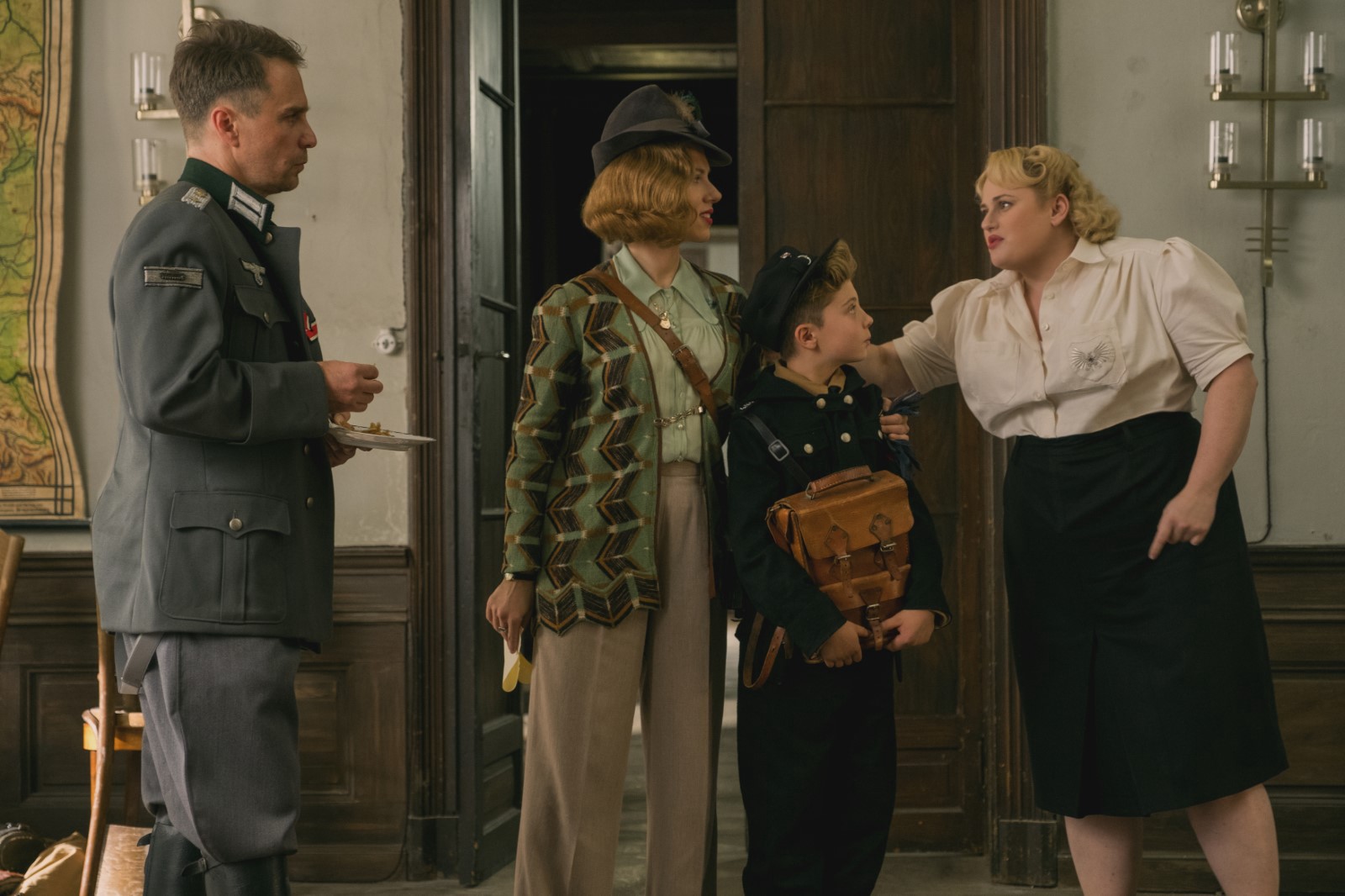
After Jojo has sufficiently recovered and is well enough to rejoin the cause, Rosie asks Klenzendorf, demoted after the incident for negligence, to make her son feel included despite his now healed but nonetheless scarred injuries. Jojo is given menial duties such as spreading propaganda material through the town, and rounding up scrap metal for the war effort.

One day, having arrived home before his mother, to an empty house, he hears noises coming form upstairs. Venturing to investigate he discovers Elsa Korr (Thomasin McKenzie), a teenage Jewish girl and a former classmate of his sister, hiding upstairs, behind the wall of Inge's bedroom. Jojo threatens to reveal her presence to the Gestapo, but Elsa warns that she, him and his mother would be killed for harbouring her. He agrees reluctantly to keep her hidden, on the condition she reveals her 'Jew secrets' so he can write a book for Klenzendorf. Elsa plays along by making up stories about the hidden powers that all Jews possess, including growing horns when they turn 21, mind reading, sleeping upside down like bats, and their preferred foods including chocolate, cookies and bread.

Jojo continues with his interrogation of Elsa, learning she has a boyfriend called Nathan with whom she wants to reunite when the war is over and live in Paris together. Jojo forges a letter from 'Nathan' and reads it aloud to Elsa in which he states that he has found someone else and wants to split up with her. Hearing her sobbing from behind the wall, Jojo writes another letter telling her to disregard the first one. Jojo and Adolf argue, with Adolf insisting Elsa is a monster, who can't be trusted. Later, while on one of his metal collecting trips, Jojo spots his mother leaving 'free Germany' postcards around town.

Jojo is home alone one day when the Gestapo come knocking on his door, led by Captain Deertz (Stephen Merchant). Klenzendorf coincidentally arrives at the house a short time afterwards while it is being searched with his second in command, Finkel (Alfie Allen). Elsa reveals herself, making out to be Inge, and produces Inge's identification papers and confirms her birthday from memory to satisfy the Gestapo's line of questioning. They also pick up JoJo's 'Jewish Secrets' hand drawn book which Deertz thumbs through and finds it very amusing, helping to diffuse an otherwise tense situation. When they have all left Jojo is relieved, but Elsa later realises she recited Inge's wrong birth date and that Klenzendorf covered for her, but is certain the Gestapo will eventually come to realise their ruse.

Later that day, Jojo stumbles across his mother who had been hanged in the town square with three others. Devastated and distraught, he returns home and stabs Elsa in the shoulder with his standard issue Hitler Youth knife barely breaking the skin, and then breaks down sobbing. Elsa comforts him.

Later on Jojo runs into Yorki, who is now a fighting soldier, who tells him Hitler has committed suicide and that the Allies are gaining ground rapidly. Jojo encounters Fraulein Rahm (Rebel Wilson), and offsider of Klenzendorf, arming and sacrificing children as the battle closes in around them, and she gives him a soldier's coat and a machine gun, before being killed herself. Confronted by both American and Soviet forces, the city's German stronghold collapses and they surrender. The Soviets have rounded up several captured Germans into a courtyard when Jojo stumbles in, having taking shelter until after the cease fire, and encounters a wounded Klenzendorf who tells the young lad that his mother was a good woman. He saves him by removing his German Hitler Youth coat, calling him a Jew, and spitting on him, leading the Soviet guards to drag him away. The soldiers thrust Jojo into the street and tell him to go home. He runs off as several shots are heard in the background.

Jojo returns home, and to stop Elsa from leaving as he has now developed feelings for her, tells her that Germany won the war. Realising her despair, he recites a new 'letter' from Nathan claiming that he and Jojo have figured out a way to smuggle her to Paris where they can live happily ever after. Upon hearing this, Elsa reveals that Nathan died the previous year. Jojo tells her he loves her, and she tells him she loves him in a 'little brother' kind of way. A beleaguered Adolf sporting a bloodied bullet hole through the head angrily confronts Jojo for siding with Elsa, and Jojo promptly kicks him out the window never to be seen again. Jojo takes Elsa outside, where she sees the Allies have won after witnessing American soldiers driving up and down the street flying the US flag. She slaps Jojo in the face for lying, and then they proceed to dance in the street to the sound of David Bowie's German Remix version from 1989 of 'Helden'.

There are some moments of real laugh out loud humour in 'Jojo Rabbit' just as much as there are some tender heartfelt emotional moments too, that keep the story grounded in all the horrors of WWII Nazi Germany. At its heart however, this is a black satirical comedy that demonstrates that despite the racial hatred, the indoctrination of an ideal from a very early age, and the brutality and horrors of war that love conquers all and a child can overcome adversity with acceptance and confidence. Roman Griffin Davis is perfectly cast in the role of Jojo and gives a revelatory performance, his best friend Archie Yates as Yorki does not a miss a beat in the delivery of his dead pan one liners and comedic turns and Thomasin McKenzie as Elsa is considered and even tempered in her delivery of raw emotion and satirical beats in her performance too. And as for the Director, Writer and star of the show as the imaginary man-child friend The Fuhrer, Waititi's performance is priceless ranging from the absurdest childlike actions of an eleven year old to the brutal and demanding rantings of the Adolf Hitler that we have all come to know and loathe. This is a quirky, whimsical film that only the off-beat humour of Taika Waititi could deliver that offers a breath of fresh air in this era of big action blockbusters that occupy so many of our cinemas screens these days, and is still a highly relevant story that resonates today as much as it did in 1944/45. It is easy to see why this film has divided audiences and Critics, but trust me, it is well worth the price of entry.

'Jojo Rabbit' merits four claps of the Odeon Online clapperboard from a possible five.
-Steve, at Odeon Online-

Thursday, 1 February 2018

DARKEST HOUR : Saturday 27th January 2018.

I saw the highly lauded and critically acclaimed WWII British drama film 'DARKEST HOUR' at the weekend, as Directed by Joe Wright, whose previous Directorial credits include 2005's 'Pride & Prejudice', 2007's 'Atonement', 2011's 'Hanna' and 2012's 'Anna Karenina' amongst a few others. The film received its World Premier screening at the Telluride Film Festival in early September last year and was also screened at the Toronto International Film Festival later that same month. It went on wide release Stateside just before Christmas and in the UK and Australia earlier in January. The film cost US$30M to make and has so far grossed US$99M, picking up a swathe of awards along the way too including so far 29 wins and 60 other nominations including six Academy Award and nine BAFTA nominations yet to be determined. Most notably, Gary Oldman has so far received 23 Best Actor award wins from around the circuit for his convincing rendition as Winston Churchill . . . and counting!

The film takes place over just three weeks in May 1940. As the film opens up, the Nazi forces are advancing rapidly on Belgium, Holland and France leaving a trail of destruction and occupation behind them. In London's Houses of Parliament, the Labour Party Opposition Leader demands the resignation of the then Prime Minister Neville Chamberlain (Ronald Pickup) because seemingly he doesn't have the wherewithal to protect the security of Britain from the advancing threat of Nazi Germany. Chamberlain advises his Conservative Party colleagues that he wants for Edward Wood, Lord Halifax (Stephen Dilate) as his successor, but Halifax declines citing that his time has not yet come. This leaves Chamberlain no option but to choose the only other candidate that the other parties will support in a Coalition Government, Winston Churchill (Gary Oldman). King George VI (Ben Mendelsohn) reluctantly invites Winston Churchill to form a new Government but states that it must include Neville Chamberlain (whom he is a supporter of) and Lord Halifax (whom he is close and trusted friend of). Secretly King George wants Halifax to be Prime Minister.

Going into Parliament for his inaugural speech Churchill is already on the back foot with many of his political peers. His track record is not so hot - the failed Gallipoli Campaign, his support of King Edward VIII during his abdication crisis, his opposition of Indian self-government, and that he twice has 'crossed the floor' already. His first speech does not garner much support, and his point blank refusal to negotiate with Hitler on peace talks also incites the ire of many who see this as the only solution to avoid annihilation.

He firmly believes that the Germans can't be trusted, and so he meets with the recently sworn in French Prime Minister Paul Reynaud, in which Churchill discounts any claims that the Allied Forces are staring down the barrel of defeat in the Battle for France. Halifax and Chamberlain agree that France is losing their battle against the Nazi's, and the surrender of Holland and Belgium is already looming ever closer. They try to persuade Churchill to engage with an Italian Ambassador who will act as the go between in peace talks between he and Hitler.  Halifax and Chamberlain plan to resign from office if Churchill refuses to enter into peace talks with Germany, which would result in a vote of no confidence so paving the way for Halifax to become Prime Minister. Churchill goes live on radio with a broadcast stating that all is not lost in France and the Allied Forces are pushing back against the German War Machine and that everyone at home can rest easy in their beds (or words to that effect!).

Meanwhile, with the advancing Germans well into French territory, the might of the British Armed Forces is forced back into a very tight corner at Dunkirk and Calais. Acting against the advice of his War Cabinet, Churchill orders that 4,000 holed up soldiers in Calais distract the German forces away from Dunkirk in order that they can be evacuated from the beach there. It means potentially sacrificing the 4,000 Calais contingent into a suicide mission in order that 300,000 British soldiers can be rescued. A prospect that does not sit well with Halifax or Chamberlain, but Churchill has little alternative in such desperate circumstances.

He initiates 'Operation Dynamo', launching a flotilla of countless small pleasure craft and motor boats and yachts to head to Dunkirk across the English Channel with all haste to rescue the British troops trapped there. This incidentally was the very subject of Christopher Nolan's excellent 'Dunkirk' film of last year, which explored the evacuation from three perspectives - the land, the sea and the air, and Joe Wright also covered the Dunkirk evacuation in his earlier film 'Atonement'. As news filters through that Belgium has surrendered, and in all likelihood France will do so very soon too, Churchill calls US President Franklin D. Roosevelt for assistance with a number of war ships to help defend Britain from the German onslaught which now appears to be imminent. Roosevelt however, declines, citing that his hands are tied by a series of Acts passed in the 1930's preventing the United States from entering into costly disputes with far away nations.

The defeat in France, the ongoing evacuation of British troops from Dunkirk which had yet to be proven successful, and the rising probability of a German invasion onto British soil results in the War Cabinet overwhelmingly voting for a peaceful negotiation with Hitler, with certain conditions attached including that Britain shall remain independent. One evening, King George VI unexpectedly visits Churchill, and pledges his support in fighting the Germans at all costs. King George had thought long and hard about fleeing Britain for Canada to rule in exile from there in the event of a German invasion, but decided against that notion. Spurred on by the King's commitment of support, Churchill  does something he has never done before. He takes a London Underground Tube ride to Westminster. Between stations he talks to members of the British public about their mood, and their preparedness to live potentially under German rule. Overwhelmingly, the men and women, old and young that he talks to, agree to fight, rejecting all notions of a peaceful negotiation and surrender.

Arriving at Westminster to address Parliament, Churchill first gathers his Outer Cabinet and any other hangers on, to seek their support to reject any further discussions about a negotiated peace, but rather to stand up and fight. All those gathered offer their agreement. Before going into Parliament to hear Churchill's address, Halifax demands of Chamberlain his commitment to continue with their plan to dispose him.  Chamberlain, stalls and is having second thoughts, saying to wait until after the Prime Minster has spoken.

Churchill stirs Parliament with a rousing speech that culminates with 'We shall fight on the beaches, we shall fight on the landing grounds, we shall fight in the fields and in the streets, we shall fight in the hills; we shall never surrender, and . . . ' At this, and with rapturous applause from the stalls and gallery, Chamberlain forgoes his plan to depose of Churchill, leaving Halifax rejected. Churchill departs. It is the 4th June 1940, and Churchill remains Prime Minister for the remaining five years of WWII until the Allies declare Victory over Germany in May 1945, but he was unsuccessful in securing a further term in the General Election held in July 1945. Chamberlain died of cancer in November 1940, and Halifax was offered a posting to become the Ambassador to the United States. The Dunkirk Evacuation under Operation Dynamo, was a huge success rescuing some 340,000 troops using a flotilla of some 800 civilian boats.

Kristin Scott Thomas also stars at Clementine Churchill, the rock behind Winston, and Lily James as Elizabeth Layton, the Secretary to Churchill, who joins him on his first day in office as Prime Minister.

This is Gary Oldman's film without doubt. He chews up every scene in which he appears either sucking on his trademark cigar or sipping a large Scotch or both - no matter what time of day or night, or what the circumstance may be. The accolades bestowed upon him are well deserved as he adds gravitas to the character and delivers a nuanced performance whether its his laconic sense of humour, the moments of self doubt, his mood swings, the intimate times with his wife and immediate family, his intelligence shining through in times of crisis, or his ability to wordsmith with the best orators in the land. And Joe Wright has delivered too another highly polished offering combining historical fact and fiction into an engrossing film that captures the look, feel and mood of Britain at this pivotal moment in history. Don't go into this film expecting all the action of Nolan's 'Dunkirk' - here the action is largely confined to a war of words and emotion that Churchill was renowned for, and for standing his ground even though all those others around him were trying to topple him. A film perhaps best suited to those mature enough to remember the war years or our school history lessons or those from that era, and less so for the millennials that may find the film too labouring, not enough action, and less than relevant in their world of today. If you don't see this film for any reason other than Gary Oldman's performance, then that is good enough reason.

-Steve, at Odeon Online-

Friday, 1 September 2017

THE KING'S CHOICE : Tuesday 29th August 2017.

'THE KING'S CHOICE' which I saw earlier this week is a WWII historical biographical drama film, and a Norwegian offering that was nominated as a Best Foreign Language Film entry into this years Academy Awards. Directed by Erik Poppe, this little known story of the dramatic events in the wartime history of Norway has received much critical acclaim as much for the Directing as the performances by the principal cast, the storytelling, the cinematography and the production values. The film cost US$8M to make and has so far grossed US$9M.

By way of a quick history lesson, the film centres around King Haakon VII - who was born Christian Frederik Carl Georg Valdemar Axel, known as Prince Carl of Denmark until 1905, and was a Danish Prince who became the first King of Norway after the 1905 dissolution of the union with Sweden. He reigned from November 1905 until his death in September 1957. As one of the few elected monarchs, Haakon quickly won the respect and admiration of his people. He played a pivotal role in uniting the Norwegian nation in its resistance to the might of the German forces as they invaded Norway and took a subsequent five-year-long occupation of his country during World War II. Regarded as one of the greatest Norwegians of the 20th Century, he is held in high esteem for his courage during the German invasion—he threatened abdication if the government cooperated with the invading Germans—and for his leadership and preservation of Norwegian unity during the occupation. He died at the age of 85 in September 1957, after having reigned for nearly 52 years and was succeeded by his only son, Olav V who reigned until his death in January 1991 aged 87.

This film tells the story of a chain of events in early April 1940 when German Nazi troops arrive in Norway's capital city, Oslo, and demand of the King - surrender or die! Norway was invaded by the naval and air forces of Nazi Germany during the early hours of 9 April 1940. The German naval detachment sent to capture Oslo was opposed by Oscarsborg Fortress located in Drobak Sound, the northernmost part of the outer Oslofjord in southern Norway. The fortress fired at the invaders with heavy artillery which the German's had underestimated, sinking the heavy cruiser Blucher and damaging the heavy cruiser Lutzow, with significant German losses that included many of their armed forces, Gestapo Agents, and administrative staff who were all set to occupy the Norwegian capital. This led to the withdrawal of the rest of the German flotilla for the time being, preventing the invaders from occupying Oslo at dawn as was their plan. The German delay in occupying Oslo, along with swift action by the President of the Storting ('the Great Assembly' being the supreme legislature of Norway) created the opportunity for the Norwegian Royal Family composing King Haakon VII (Jesper Christensen), his son Crown Prince Olav (Anders Bassmo Christiansen) and his wife Crown Princess Martha (Tuva Novotny) and their three young children, the Cabinet, and most of the 150 members of the Storting to make a hasty and discreet departure from the capital by special train.

The King and his family, and the members of the Storting first convened at the town of Hamar that same afternoon, but with the rapid advance of German troops, the group moved on to Elverum and holed up in various farm houses there that would offer refuge. The assembled Storting unanimously enacted a resolution, the so-called Elverum Authorization, granting the Cabinet full powers to protect the country until such time as the Storting could meet again. In the meantime, the Prime Minster tenders his resignation, and with it the dissolution of the Cabinet, effectively leaving Norway without a government, at a time when it desperately need it the most. Needless to say the King does not accept the resignation of the Prime Minister or the disbandment of the Storting, and addresses the gathered Cabinet leaders in a theatre in the town to tell them it has got to be business as usual, and hunker down to thwart the advancing German threat to them all.

Meanwhile Curt Brauer (Karl Markovics) as the German Envoy to Norway is actively trying to broker a peace deal that will halt the German invasion and the unnecessary shedding of blood, and electing a puppet government headed up by the fascist Vidkun Quisling, who only hours earlier had declared himself Norway's new Prime Minister. Had the King approved his appointment, it would effectively have legally sanctioned the German invasion. Brauer is fast running out of time and is gaining little support from the German officer who takes his orders from Berlin, and that is to advance at all haste and take Norway by force if necessary. Brauer takes a direct telephone call from Adolf Hitler saying for him to broker a deal with the King, and the King only, and to do it quickly and with the desired outcome. 

By now the German forces had passed through Hamar and were converging on Elverum. A small ground force of Norwegian reservist soldiers form a barricade and make ready for the arrival of the German troops under cover of darkness. Meanwhile, the King, Olav and the Cabinet have fled for Nybergsund. At this point the King makes the decision that it is way too dangerous for the family to stay together and move about the country as one unit, and that the Crown Princess and the three children should seek safe refuge in neighbouring Sweden, leaving the King and his son to continue their journey and oversee the task in hand. The Germans arrive at Elverum and quickly overpower the Norwegian armed contingent, many of them no more than teenage boys who hold off for long enough only to cause a temporary inconvenience for the advancing invaders.

Brauer demands a meeting with the King in an attempt to broker a deal as required directly by Hitler. Brauer travels to Nybergsund and is halted at a checkpoint where he is ordered out of his car, blindfolded and taken to a secret location where the King and the Cabinet are holed up. The King staunchly demands that the key four members of the Storting remain present for the meeting, but Brauer will have none of this, recounting his orders from Hitler himself to deal with no-one but the King. Brauer threatens to leave, and so the King relents and the two talk alone. Brauer suggested that Haakon should best follow the example of the Danish government and his brother, the King there, who had surrendered almost immediately after the previous day's invasion, and threatened Norway with harsh reprisals if it did not surrender. Haakon tells Brauer that he cannot make such a decision himself, and only on the advice of the Government, and the people of Norway who had democratically voted him in as their King thirty-five or so years previously.

After Brauer leaves without the Kings signature on his papers, Haakon delivers an impassioned speech to the gathered Cabinet. He advises of the German ultimatum and that he was not in a position to make such a decision himself, even though he knows he has the power to influence such a decision. He knows the implications of his choice upon the people and his country of Norway, and states that such a decision must rest with the Government which he will accept either way, albeit his decision is clear. He goes on to add that he cannot sanction Vidkun Quisling as Prime Minister because he knows that Quisling has neither support of the people or the Storting. If however, the Cabinet feels otherwise, he and his family will abdicate their positions as Norway's Royal Family, so as not to be seen as an obstacle to the Government's decision. This sends a shockwave through the room.

Later that evening Brauer receives a telephone call advising him of the King's choice not to accept the ultimatum. Early the next morning the thunderous sound of German bombers overhead all but destroy the town where Haakon, Olav and the Government have been staying, in an attempt to wipe out Norway's unyielding monarchy. The King and his Ministers seek refuge in the snow covered forest nearby and escape harm. Ultimately Haakon, Olav and his family are reunited in London after the war has ended, where the King and the Crown Prince sought exile during the war years and continued their resistance of the German occupation of their country from afar.

'The King's Choice' is a dialogue heavy film, with a few moments of action to break up this story of three days of defiance in the face of extreme adversity that changed the course of Norwegian history, or as the Norwegians would have us believe. Yet despite the stoic stiff upper lip principles of King Haakon, Norway was a sovereign territory, largely neutral in its war effort and certainly ill equipped to deal with the might of the heavily armed, forceful and relentless German war machine. And so the King is in a real quandary here - hand his country over to the great oppressor on a silver plate to be ruled over by a fascist tyrant, or face an unknown future as a result of his single minded defiance! This film is made by Norwegians, about a moment in the history of Norway, for largely Norwegians, and on that level I can see the appeal, but to the rest of the world, will this film hold that much interest I wonder? The performances are solid enough, the production values speak volumes more than the US$8M budget would have us believe, the hand held camerawork adds an immediacy to the proceedings albeit is a little shaky at times, but for me the film labours on about three days to reach a determination that had little consequence on Germany's occupation of Norway, other than to save the life of the King and his family, and poke a stick momentarily in the eye of Adolf Hitler. All that said, I certainly learned something about WWII and this lesser known story of Norwegian grit, determination, and resistance even if some liberties are taken to keep the story moving along and engage the audience for its 130 minute running time. You don't need to see this on the big screen and can easily wait for the DVD and BluRay release.

-Steve, at Odeon Online-

Thursday, 27 July 2017

DUNKIRK : Monday 24th July 2017.

I saw 'DUNKIRK' in its 70mm format in one of only 159 cinemas worldwide showcasing this film in this way, and I'd have to say, that this is the only way to see this film! Back in the early '90's Christopher Nolan and his future wife, movie Producer and film collaborator Emma Thomas, were sailing across the English Channel to Dunkirk, when the young Writer and Director hit upon an idea for a film, about the evacuation of British armed forces from the war torn beaches of Dunkirk in mid-1940. He committed his idea to a 76 page Screenplay, and then put the whole idea on hold until such time as he had gained sufficient experience in making big epic blockbusting action film fare - the like of which he has more than proven he can do over the subsequent years. However, rather than making a film about the war time politics involving Churchill and his Generals; or showing the Germans on the beach head taking out allied forces with their strategically located gun placements; or paint this as a victory; or bring in Uncle Sam to save the day, he chose to make a film with an all English cast and from three perspectives - the air (involving Spitfire and Luftwaffe dog fights), the land (on the beaches of Dunkirk), and the sea (the evacuation of 400,000 troops by the Navy and any able bodied sea man who could steer a dinghy across the Channel to aid the rescue attempt).

And so armed with an ensemble cast of fine and lesser known English acting talent, Nolan has created a WWII action drama film where the dialogue is thin on the ground and there is no character backstory, instead allowing the suspense to come through the details and the authentic fact based story contained within the scenes. Nolan also made extensive use of practical effects - employing some six thousand extras, amassing a flotilla of boats that had participated in the real Dunkirk evacuation, and using genuine era-appropriate planes for aerial sequences. The film centres around the evacuation of British, French, Belgian and Canadian troops who are pinned down by German forces on the beaches and harbour of Dunkirk, and their evacuation between 26th May and 4th June 1940 in what was known as 'Operation Dynamo'. The film Premiered in London on 13th July and was released worldwide last week, having cost US$100M to make it has so far grossed US$122M and has met largely with widespread acclaim.

The film is a triptych, with each separate clearly defined story overlapping through their engagement with the enemy while recounting the heroics, the ever present danger, the chaos and the gritty determination of everyday airmen, sea men, soldiers on the ground and the British general public in their concerted rescue attempts as they come under a constant barrage of attack by land, sea and air from the German forces. Told in a non-linear narrative style covering three different time periods - one on land covering a week and staged at one of two Moles protecting the outer harbour at Dunkirk from which ships were able to dock to evacuate the troops; one from the sea covering one day as the Royal Navy commandeer private boats to aid the rescue attempt across the English Channel; and one from the air covering one hour as a small squadron of three Spitfires fly across the Channel to provide air support to the men on the ground in Dunkirk. As the film opens up, an introductory text tells us that in 1940, after the invasion of France by Nazi Germany, thousands of Allied soldiers retreated to the French seaside town of Dunkirk. As the surrounding British perimeter shrinks, the soldiers await evacuation, a seemingly hopeless situation.

And so to the Mole, on land, where we meet young British Private Tommy (Fionn Whitehaed) who after a close encounter with German snipers survives and makes it behind Allied lines to the relative safety of Dunkirk beach and the amassed hordes of British and allied troops eagerly anticipating their imminent evacuation. There he meets Gibson (Aneurin Bernard) and the two stretcher an injured soldier across the beach to a waiting ship evacuating the wounded. The two lads are denied entry to the outgoing ship, but the injured man is carried aboard. Tommy and Gibson stow themselves away under the infrastructure of the Mole hoping to sneak abroad the next ship. German attack planes descend on the Mole, sinking the outgoing ship as it is about to leave the dock. In the chaos, the boys are thrown into the sea and save young Alex (Harry Styles) from being crushed as the ship sinks. They get on another boat later that night, but that is torpedoed by a German U-Boat and this time Gibson saves Tommy and Alex. The next day the three lads join a small group of Scottish soldiers who have spied a grounded fishing trawler further up the beach outside of the Allied perimeter. Hiding inside the vessel waiting for the tide to rise to refloat the boat, they are set upon by German soldiers who use the trawler for target practice shooting many holes in the boats hull, to the extent that when the boat does finally rise it lets in so much water that the men have to abandon it soon afterwards. As the vessel sinks, Gibson becomes entangled in some rigging and drowns. Alex and Tommy swim for a nearby minesweeper, but it is bombed and sinks. They are eventually picked up by Mr. Dawson's (Mark Rylance) boat in the vicinity of the sunken minesweeper that has been leaking oil heavily into the sea. They narrowly escape being engulfed in flames as a German plane is shot down and crashes into the sea in a ball of flame so igniting the oil slick. Mr. Dawson picks up a boat load of oil caked survivors and heads back for the white cliffs of England, and home.

Meanwhile on the Mole, Commander Bolton (Kenneth Branagh) has taken charge of the proceedings as the pier-master to coordinate the rescue and evacuation efforts. Together with Colonel Winnant (James D'Arcy) they discuss Churchill's rejection of Germany's offer for Britain to surrender and his commitment to see to it that 30,000 servicemen are evacuated, and that smaller civilian vessels had been ordered to aid the evacuation attempt to save the larger fleet for the defence of Britain. As the last vestiges of the British soldiers had been evacuated by a flotilla of smaller English boats of every size and description, so Winnant departs expecting Bolton to go with him. But stoically, Bolton stays behind stating that 300,000 British troops had been evacuated, and he would see to it that the French were next to be rescued.

To the sea, and Mr. Dawson does his duty to King and country without hesitation and sets of his motor cruiser (the 'Moonstone') with his son Peter (Tom Glynn-Carney) and teenage deck hand George (Barry Keoghan). Soon after departing into the English Channel they spot three Spitfire planes over head. The vessel shortly afterwards comes across a semi-sunken ship with a lone survivor sitting on the hull of the upturned vessel. They rescue him and welcome the bitterly cold soldier aboard (Cillian Murphy) who is clearly shell shocked. The soldier becomes very agitated when he learns that Dawson is heading to Dunkirk and not to England and demands that the boat be turned around immediately, saying that he cannot go back there for fear of certain death. A scuffle ensues, George is knocked below deck injuring himself badly and the soldier is ordered to sleep it off below deck. Dawson continues heading toward France. En route they witness a Spitfire ditch in the sea, and going to its rescue they haul out RAF Pilot Collins (Jack Lowden) who was about to drown in the cockpit of his rapidly sinking Spitfire. They then come across a stricken minesweeper under attack by a German bomber, and manoeuvre the vessel to take on soldiers fleeing the listing ship and spilling oil heavily into the sea - among them Tommy and Alex.

In the air, RAF Pilot Farrier (Tom Hardy) and two others - Collins and their Squadron Leader fly low over the English Channel to provide air support to the troops on the ground in Dunkirk. Along the way they encounter a Luftwaffe plane which shoots down the Squadron Leader. Farrier and Collins continue towards France monitoring their dwindling fuel supply regularly. In another mid-air skirmish the pair take out another German plane, but Collins has sustained damage to his Spitfire and is forced to ditch at sea. Farrier continues on regardless unaware of what the outcome was for his flying mate. Getting closer to France Farrier must switch to reserve fuel now. He then witnesses the bombing of the minesweeper and the sinking of the trawler on which Tommy and Alex managed to swim free. Reaching Dunkirk he takes out the German bomber aircraft that was hampering the evacuation attempts, so saving ships and lives in the process. He runs out of fuel and glides along the beach to the rapturous applause of the soldiers below, seeking a landing spot on the sand. He brings his aircraft down gently on the sand but outside of the Allied perimeter. He torches his plane and as it erupts in a ball of flame with him looking on, so he is taken prisoner by German soldiers.

'Dunkirk' adds another dimension to the history of war films in cinema just as 'Saving Private Ryan' did in 1998. Without getting bogged down in the political agenda of the WWII era, or the labouring back story of the principle cast, or the rights and wrongs as seen by either side, here Christopher Nolan has crafted a war film that is very much of a moment in time from the perspective not of heroes, but of everyday men responding to extraordinary circumstances in differing situations. We have young foot soldiers doing what they can to survive - run, hide, duck and weave; we have an ageing father doing his bit for his country to help bring his boys back home in their hour of need; we have a fighter pilot with a do or die attitude; and we have a naval commander who simply gets the job done with the minimal amount of fuss and then hangs back to do it all over again. Knowing the truth behind the Dunkirk evacuation makes this all the more a grounded story, backed up by strong performances, a stirring score by Hans Zimmer, and masterful Direction and Cinematography courtesy of Hoyte van Hoytema (who also worked with Nolan on 'Interstellar'). If I had any criticism it would be that the characters are emotionally bereft. They are all stoic, stiff upper lip, never say die middle class Englishmen with their focus squarely on the job at hand, and a such it's a little tough investing in them, and, in addition what of the role of women here - women in this film are banished to handing out cups of tea and jam sandwiches to evacuating troops below decks, but history tells us that they had more important roles to play! All that said, the film is rousing, stirring, uniquely realised, and totally immersive, and a must see on the biggest screen you can possibly find, and ideally in 70mm.

-Steve, at Odeon Online-