Showing posts with label Gary Oldman. Show all posts

Friday, 28 July 2023

OPPENHEIMER : Tuesday 25th July 2023.

'OPPENHEIMER' 
which I saw at my local independent movie theatre this week is an MA15+ Rated American biographical war drama film Written, Co-Produced and Directed by Christopher Nolan, and is based on the 2005 biography 'American Prometheus' by Kai Bird and Martin J. Sherwin. Christopher Nolan's prior film making credits take in his debut with 'Following' in 1998 then 'Momento' in 2000, 'Insomnia' in 2002, 'Inception' in 2010, 'Interstellar' in 2014, 'Dunkirk' in 2017, 'Tenet' in 2020 with the 'Batman' trilogy in between time in 2005, 2008 and 2012. The film cost US$100M to produce, saw its World Premiere showcasing in Paris on 11th July, was released in the UK, the USA and here in Australia last week, has so far grossed US$242M and has garnered universal critical acclaim.

The film opens in 1926 with a dishevelled looking 22-year-old J. Robert Oppenheimer (Cillian Murphy) who has trouble sleeping at night and grapples with homesickness and anxiety while studying under the British experimental physicist Patrick Blackett (James D'Arcy) at the Cavendish Laboratory in the University of Cambridge, England. Oppenheimer finds Blackett demanding and injects an apple he leaves on his desk with cyanide which visiting scientist Niels Bohr (Kenneth Branagh) almost bites into but not before Oppenheimer thrusts it out of his hand and into a waste bin. Oppenheimer completes his PhD in physics at the University of Gottingen in Germany, where he is introduced to Werner Heisenberg (Matthias Schweighofer). He returns to the US, in the hope of expanding quantum physics research, and starts teaching at the University of California, Berkeley and the California Institute of Technology. During this period, he meets Jean Tatlock (Florence Pugh), a member of the US Communist Party with whom he has an on-again off-again affair until her eventual suicide in 1944, and later his future wife Katherine 'Kitty' Puening (Emily Blunt), a biologist and ex-Communist whom Oppenheimer married in 1940 and with whom he has two children.

US Army General Leslie Groves (Matt Damon) enlists Oppenheimer to spearhead the Manhattan Project in order to develop an atomic bomb after Oppenheimer assures Groves that he has no communist sympathies. Oppenheimer, a Jew, is particularly focused on the Nazis and the very likely possibility that they have their own nuclear weapons programme underway, headed up by Werner Heisenberg. 

Oppenheimer recruits a scientific team that includes Edward Teller (Benny Safdie), Isidor Isaac Rabi (David Krumholtz) and David L. Hill (Rami Malek), to a purpose built town in the middle of nowhere at Los Alamos, New Mexico, to begin work on secretly creating the atomic bomb. During the development, Oppenheimer and Albert Einstein (Tom Conti) discuss how such a bomb could possibly trigger a chain reaction that has the potential to destroy the world. Oppenheimer also learns of a possible Soviet spy within his ranks who has potentially leaked the Manhattan Project's secretive intelligence data to the Russians.

When Germany surrenders in May 1945 some project scientists cast doubt over the bomb's continued importance. The bomb is completed and the initial 'Trinity' test is successfully conducted on 16th July 1945 just before the Potsdam Conference involving Winston Churchill, Harry S. Truman and Joseph Stalin which began on 17th July in Potsdam, Germany. US President Harry S. Truman (Gary Oldman) decides to drop atomic bombs on the Japanese cities of Hiroshima and Nagasaki on 6th and 9th August 1945 respectively forcing Japan's surrender and thrusting Oppenheimer into the public eye as the 'father of the atomic bomb'. Haunted by the immense destruction and suffering the bombs caused, Oppenheimer personally urges Truman to use restraint in developing even more powerful weapons, saying that he has 'blood on his hands'. Truman perceives Oppenheimer's anxiety as a weakness, and states that, as President, he alone bears responsibility for the bomb's use. Upon leaving the Oval Office feeling very dejected Truman says to his aide that he doesn't ever want to see that 'scientist crybaby again'. Oppenheimer continues feeling intense remorse.

Oppenheimer is outspoken, in government circles, about any further nuclear development, especially of the hydrogen bomb, positioning him against Teller. His steadfast opinions become a point of contention amid the escalating Cold War with the Soviet Union. Lewis Strauss (Robert Downey Jnr.), chairman of the US Atomic Energy Commission, has a personal beef against Oppenheimer for publicly dismissing his concerns over the export of radioisotopes and, as per Strauss' belief, badmouthing him to Einstein. 

At a four week kangaroo court hearing in 1954 intended to remove Oppenheimer from any and all political influence, and as largely cross examined by Roger Robb (Jason Clarke), Oppenheimer is betrayed by Teller's and other associates' testimony, including the final nail in the coffin delivered by William L. Borden (David Dastmalchian),stating that he firmly believed that J. Robert Oppenheimer was an agent of the Soviet Union. Meanwhile Strauss exploits Oppenheimer's associations with current and former communists such as Tatlock and Oppenheimer's brother Frank (Dylan Arnold).

Despite Rabi and several other allies testifying in Oppenheimer's defence, Oppenheimer's security clearance is revoked by a vote of 2 -1 although his loyalty to the United States was not brought into question. However, this did damage his public image and reduced to zero his policy influence. Later, at Strauss' Senate confirmation hearing as Secretary of Commerce, Hill exposes Strauss' personal motives in engineering Oppenheimer's downfall, which results in Strauss' confirmation being denied.

In 1963, President Lyndon B. Johnson presents Oppenheimer the Enrico Fermi Award (awarded to honour scientists of international stature for their lifetime achievement in the development, use, or production of energy) as a gesture of political rehabilitation. It is revealed that Oppenheimer and Einstein's earlier conversation was not about Strauss but rather nuclear weapons and their far-reaching impacts ultimately. Oppenheimer muses whether the Trinity test, to a large extent, his creation, could launch a chain reaction of events that could lead to a nuclear holocaust. 

'Oppenheimer'
is possibly Christopher Nolan's best film offering yet, and that's saying something given the quality of his varied back catalogue over the past twenty or so years. Here he has crafted a film that is well scripted, stunningly photographed, and packed with emotion, intrigue, a stellar ensemble cast and an underlying message that is just as important today as it was almost eighty years ago. Cillian Murphy gives a tour-de-force performance as the torn and troubled Oppenheimer wrestling with his own inner demons over the magnitude of his creation and the implications for all of humankind, and is more than ably supported by Emily Blunt, Matt Damon and Robert Downey Jnr. This is a compelling film that tells the story of war, the people wielding the power and who you can ultimately trust that needs to be viewed on the biggest screen you can get to. It deserves all the accolades bestowed upon it come awards season, and despite it being largely a dialogue driven drama grips the attention from the get go, until the final half hour where the story drags just a little - but don't let that put you off. One of the must see films of the year for sure. Also starring Josh Hartnett, Casey Affleck, Dane DeHaan, Matthew Modine, Scott Grimes, Alden Ehrenreich, James Remar and Olivia Thirlby.

'Oppenheimer' merits four claps of the Odeon Online clapperboard from a potential five claps.
-Steve, at Odeon Online-
Saturday, 3 April 2021

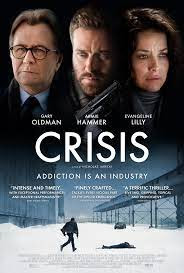
CRISIS : Tuesday 30th March 2021.

'CRISIS'
, which I saw at my local multiplex this week, is an MA15+ Rated crime thriller Directed, Produced, Written and also starring Nicholas Jarecki in only his second feature film making outing following 2012's 'Arbitrage' with Richard Gere, Susan Sarandon and Tim Roth. The film was released in the US in late February, and in Canada and Australia two weeks ago now, having gained mixed or average Reviews along the way. Featuring an ensemble cast that takes in the likes of Gary Oldman, Armie Hammer, Evangeline Lilly, Greg Kinnear, Luke Evans, Michelle Rodriguez, Lily-Rose Depp, Indira Varma, Kid Cudi and Martin Donovan the film has so far grossed US$986K at the Box Office. 

And so the film opens up with an action sequence that sees a white clad camouflaged drug runner pulling a makeshift sleigh thorough a forest and in the snow only to be ambushed and subsequently arrested by Police in a helicopter and on snowmobiles while trying to smuggle Fentanyl across an unpatrolled stretch of the Canadian border, about forty miles south of Montreal.

Meanwhile, back in Detroit, following the arrest, Jake Kelly (Armie Hammer) goes into damage control with a pair of Armenian gangster associates Minas (Michael Aronov) and Armen (Adam Tsekhman). He then risks blowing his cover to visit his drug addled younger sister Emmie (Lily-Rose Depp) seemingly recovering in a rehab facility, but largely non compos mentis. Kelly, who we subsequently learn is in fact an undercover DEA Officer, holds a briefing with his colleagues to bring them up to speed with his operations, which he has been working on for over a year now to infiltrate the Armenian's and gain their confidence that he is on the level. 

While this is going on the second story strand launches with architect Claire Reimann (Evangeline Lilly) attending a drug users survivors meeting recounting her former acute addiction to OxyContin, without realising just how close to home the trade has become in illicit drugs when her sixteen year old mad sports keen fan son David (Billy Bryk) goes missing, and winds up very dead seemingly overdosed on OxyContin. 

The third strand unravels in the hallowed halls of a university campus where charismatic professor of biology Dr. Tyrone Brower (Gary Oldman) teaches a captivated lecture theatre, but may be about to compromise his integrity in his lab by conducting drug trials directly sponsored for the last seven years by a major pharmaceutical company. When Brower’s lab assistants come to the realisation that a new wonder drug, Klaralon, is three times more addictive than other painkillers on mice (and fatal when taken to excess, although claimed to be non-addictive), he’s torn by what to do with this revelation. 

Enter Big Pharma Executive Dr. Bill Simmons (Luke Evans) to offer Brower’s department a US$780K grant in exchange for enhanced nondisclosure terms, updating and making even more watertight those signed seven years previously. But then the Principal of the University, Dean Talbot (Greg Kinnear) basically intervenes and tells him not to worry about the results on the mice, to sign the non-disclosure statement and take the much needed funding to enable Brower to continue with his research. This turn of events puts Brower in an even greater quandary.

In the meantime, Jake Kelly and his DEA partner Stanley Foster (Nicholas Jerecki) are under pressure to bring their undercover operation to a close within the next two weeks, otherwise it will be shut down. Kelly has a meeting with Supervisor Garrett (Michelle Rodriguez) at which this news is broken. Kelly arranges a meeting with the drug smuggling kingpin, known only as Mother (Guy Nadon) in an attempt to fast track a US$3M cash trade for two truck loads of Fentanyl, hidden inside vitamin bottles. Mother is initially reluctant, but ultimately agrees to the manufacture of the drug in the volume required and the sale of it to Kelly. 

At the same time, Claire Reimann is recovering from the tragic loss of her son, smells a rat as a result of the autopsy revealing a substantial bruise to his head, and the manner in which he died. She starts to do some of her own digging, which leads her to Derrick Millebran (Duke Nicholson), a former at arms length associate of her son, where it is revealed that David didn't even know he was acting as a mule for a stash of Fentanyl that he was carrying in his back pack while cycling home. He was poisoned by Mother by forcing on overdose of the drug down his throat.

Brower, after wrestling with his conscience decides to expose the pharmaceutical company to the FDA as a Whistleblower. Talbot and he have a falling out, with the Principal saying that such tests on mice are deemed inconclusive anyway, and as the pharmaceutical were in the final stages of human trials anyway it really didn't matter. Needless to say, the University and the big pharma company begin dredging up dirt on Brower to discredit him which ultimately costs him his job and his twenty plus year friendship with Dean Talbot. Brower's wife Madira (Indira Varma) is however, very supportive of her husband and remains stoic throughout. After his dismissal from the university, he is attending the FDA hearing with his contact their Ben Walker (Kid Cudi) where basically his findings are dismissed, he is not permitted to speak to give his viewpoint, Klaralon is passed and authorised for public use, Walker is 'reassigned', and the big pharma company walks away with all the spoils, overseen by Dr. Bill Simmons, Meg Holmes the CEO of the company (Veronica Ferres) and the two owner brothers of the company Lawrence (Martin Donovan) and Harold Morgan (Marcel Jeannin).   

Reimann has in between time hired a Private Investigator to do some digging on Mother (bacause as an ordinary citizen she wouldn't have access to the type of intelligence that a PI would of course), and at the same time provide her with a gun, as it has become blatantly obvious that she intends to kill the man responsible for her sons death. Kelly has set up the deal with Mother for him to manufacture the pills, bottle and label them in vitamin canisters, in exchange for US$3M - US$1M of which he has been authorised by Garrett to use, with the other US$2M coming from his Armenian contacts Minas and Armen. A time is set for the exchange in an abandoned warehouse with Stanley Foster in a surveillance truck on standby with the cavalry waiting in the wings poised ready to pounce given the signal. But of course these things never go according to plan and a firefight breaks out with Kelly getting shot cleanly in the chest by Mother who then makes his escape. In the firefight, Kelly recovers having been wearing a bullet proof vest of course, but Foster is shot in the neck, bleeds out and dies in Kelly's arms. Kelly gives chase to Mother but he is gone having been whisked away in a car. 

The PI calls Reimann on her mobile phone and informs her that Mother owns a seaplane that is kept down at the docks, and in all likelihood he'll be headed for there to make his getaway. Kelly meanwhile, sits in front of his Chief with Garrett to be told that the case is now being closed down. Needless to say he in none to pleased at this prospect given that the killer of his partner is still free. He runs off to the bar which Mother owned, beats up on the barman demanding to know where Mother is. Under duress and at gunpoint the barman says that Mothers owns a seaplane down at the docks and that is probably where he's headed. As Kelly pulls up and parks amongst the stacked containers and out of sight, he notices Reimann also parked there, patiently awaiting the arrival of Mother. A car pulls up and out steps Mother and another. Reimann gets out of her vehicle and points her weapon at Mother and calls out to him. He turns and she hesitates, giving him time to pull his weapon. She fires three or fours rounds at Mother killing him, but not before being shot herself in her arm before he went down. Kelly takes care of the other man as he runs to Reimann to lend her assistance. 

With both Mother and his associate dead on the ground, Kelly exchanges Mother's pistol for Reimann's, picks up all the dead rounds from Reimann's gun and places them on the ground next to Mother, and then they both drive off in her car. In a hotel room Kelly is bandaging up Reimann's arm. She asks Kelly if he is now going to take her off to prison, at which he responds with a no.

A lot of comparisons have been drawn between 'Crisis' and 2000's Steven Soderbergh Directed 'Traffic' which tells the story of the lives of four people which intertwine because of the drug trade in America. Each experiences personal loss and despair in the ongoing war on drugs, but is helpless. Sure enough there are similarities but that film was made twenty+ years ago and the war on drugs has moved on since then and there is a whole new audience out there probably unfamiliar with that multi award winning and nominated feature film. Here the plot moves along at a good pace, has certainly got something to say about opioid addiction, and the performances of the principle cast is spot on - particularly that of Evangeline Lilly whose grief stricken role is believable and relatable. The film doesn't take us in a new direction and the third act lurches into predictable familiar territory, but nonetheless this is a solid enough story from second time Director Jerecki that makes this film worth the price of your cinema entry.

'Crisis' merits four claps of the Odeon Online clapperboard from a possible five claps. 
-Steve, at Odeon Online-

Friday, 27 November 2020

MANK : Tuesday 24th November 2020.

'MANK' 
which I saw at my local independent movie theatre this week, is an M Rated American biographical drama film Directed and Co-Produced by the multi-award winning and nominated David Fincher, whose previous film making credits include his debut 'Alien 3', then 'Se7en', 'The Game', 'Fight Club', 'The Curious Case of Benjamin Button', 'The Social Network', and 'Gone Girl' amongst others. This film is based on a script written by David Fincher's father Jack Fincher which he wrote in the '90's with David wanting to film it following 'The Game' in 1997 but it never eventuated because David wanted to shoot the film in black & white to maintain an authenticity of the period in which the film is set ie. the Hollywood of the 1930's and '40's. At that time no studio wanted to shoot a film in black and white and when father Jack died in 2003 the film was put on the back burner, until mid-2019 when Netflix International Pictures put the movie into production. The film has garnered positive critical acclaim, and went on a limited cinematic release from last week before streaming on Netflix from 4th December. 

The film opens up in 1940 with a car motoring along a dusty highway and turning off at Victorville and driving up to the North Verde Ranch where Herman K. Mankiewicz (Gary Oldman) alights from the vehicle on crutches, assisted by his good friend and writing collaborator John Houseman (Sam Troughton) and English typist Rita Alexander (Lily Collins) and a German nurse Fraulein Frieda (Monika Grossman). Mankiewicz (or 'Mank' as he shall be known) has a broken leg in three places from a recent motor vehicle accident. Laying down in an adapted bed he receives a phone call from Orson Welles (Tom Burke) about a screenplay he has been commissioned to write in ninety days, only Welles tells him that he now has sixty days. Mank is not happy about the news but relents and accepts the direction from the Producer, Director and star of the upcoming film, which the studio, RKO Pictures, have given him complete creative control over - not bad for a 24 year old untried and largely unproven movie maker.

And so Mank gets to work on the script at the alcohol free ranch much to his chagrin, although he is able to get dosed up on bottles of barbiturates provided by Houseman instead of whisky, which has the effect of knocking him out cold for twelve hours at a time. Ultimately, Mank is able to smuggle in to the ranch a crate loaded full of his favoured whisky, unknown to Houseman. With Mank dictating the words to his script for Rita to write down long hand and then type up at night, the process is sporadic at best and with the sixty day deadline looming he has still only one hundred pages completed in what Houseman describes as beautifully written, but incoherent and too high brow for American audiences to grapple with for their 25cents cinema ticket price. Mank however, persists along his chosen path.

In the meantime, we see constant references and flashbacks to various key dates in the previous decade, and his meetings, run ins, business and personal relationships with the likes of screen Actress Marion Davies (Amanda Seyfried) and mistress to William Randolph Hearst (Charles Dance) the famed American businessman, newspaper publisher and politician, whose life story was to be the main inspiration for Mank's screenplay of Charles Foster Kane - the lead character that would be portrayed by Orson Welles in the 1941 film 'Citizen Kane'. 

In addition we see his dealings with Louis B. Mayer (Arliss Howard) of Metro Goldwyn Mayer fame; prolific Hollywood film Producer Irving Thalberg (Ferdinand Kingsley); American film Producer, Screenwriter and Executive David O. Selznick (Toby Leonard Moore); Mank's brother and Director, Producer and Screenwriter Joseph L. Mankiewicz (Tom Pelphrey) and of course Mank's long suffering but fiercely loyal wife Sara (Tuppence Middleton). 

And naturally there are sub-plots along the way that centre around Mank's heavy drinking and alcoholism (which would eventually kill him in 1952 at the age of just 55), his propensity to gamble on almost anything, the successful attempt by Irving Thalberg who was an MGM Studio Executive at the time to swing the 1934 California Governor's election against the socialist candidate Upton Sinclair (Bill Nye), and his declining relationship with Hearst, which culminates with a drunken rant by Mank at Hearst Castle at San Simeon aimed at Hearst and Mayer and in front of other Hollywood movers and shakers who all one by one get up and leave the dinner table out of disgust or embarrassment or both. And of course the ever looming deadline counting down on sixty days by which time Mank has his final draft of three hundred pages, but doubts that it is really any good until Houseman and brother Joseph tell him that it is probably his finest work. 

In the final analysis Mank's script for the film that would become 'Citizen Kane' was nominated for an Academy Award in every possible category, but won the award only for Best Original Screenplay for co-authors Mank and Orson Welles. Neither Welles nor Mankiewicz attended the dinner, which was broadcast on radio. Welles was in South America filming 'It's All True', and Mank refused to attend. George Schaefer, who was President of RKO Pictures in 1941 when the film was made, accepted Mank's Oscar in his absence. It should be noted that Mank and Welles clashed over the writing credit for 'Citizen Kane', with Welles reportedly offering Mank a bonus of US$10K if he would let Welles take full credit. Mank went to the Screen Writers Guild for a determination, and they eventually laid down a joint credit with Mank's name appearing first. Welles maintained that he had always intended to share the writing credit. 

'Mank' is a beautifully shot film looking as though it was filmed in the late 1930's in crisp black and white by Cinematographer Erik Messerschmidt; the dialogue is sharp, emotive and mature; the production values top notch; and the cast are all uniformly good but special mention must go to Gary Oldman who once again inhibits his character in every sense and every scene - just as he did with his Academy Award winning turn as Winston Churchill in 2017's 'Darkest Hour'. And Fincher here has crafted a film that serves as a stirring footnote to Hollywood's 'Golden Age' of domineering studios, those who ran them, and the rot that lurked largely hidden beneath. The film is entertaining, thought provoking, stylishly made, has a haunting soundtrack by regular musical collaborators Trent Reznor and Atticus Ross, and Fincher has here once again proven that he is right up among the best that Hollywood has to offer and is at the top of his game. Oscar bait for sure and worthy of repeat viewing that will be right up the street of every cinephile, but if you're not one of those, then there is a chance this film will be lost on you.

'Mank' merits four claps of the Odeon Online clapperboard from a possible five claps. 

-Steve at Odeon Online-

Thursday, 1 February 2018

DARKEST HOUR : Saturday 27th January 2018.

I saw the highly lauded and critically acclaimed WWII British drama film 'DARKEST HOUR' at the weekend, as Directed by Joe Wright, whose previous Directorial credits include 2005's 'Pride & Prejudice', 2007's 'Atonement', 2011's 'Hanna' and 2012's 'Anna Karenina' amongst a few others. The film received its World Premier screening at the Telluride Film Festival in early September last year and was also screened at the Toronto International Film Festival later that same month. It went on wide release Stateside just before Christmas and in the UK and Australia earlier in January. The film cost US$30M to make and has so far grossed US$99M, picking up a swathe of awards along the way too including so far 29 wins and 60 other nominations including six Academy Award and nine BAFTA nominations yet to be determined. Most notably, Gary Oldman has so far received 23 Best Actor award wins from around the circuit for his convincing rendition as Winston Churchill . . . and counting!

The film takes place over just three weeks in May 1940. As the film opens up, the Nazi forces are advancing rapidly on Belgium, Holland and France leaving a trail of destruction and occupation behind them. In London's Houses of Parliament, the Labour Party Opposition Leader demands the resignation of the then Prime Minister Neville Chamberlain (Ronald Pickup) because seemingly he doesn't have the wherewithal to protect the security of Britain from the advancing threat of Nazi Germany. Chamberlain advises his Conservative Party colleagues that he wants for Edward Wood, Lord Halifax (Stephen Dilate) as his successor, but Halifax declines citing that his time has not yet come. This leaves Chamberlain no option but to choose the only other candidate that the other parties will support in a Coalition Government, Winston Churchill (Gary Oldman). King George VI (Ben Mendelsohn) reluctantly invites Winston Churchill to form a new Government but states that it must include Neville Chamberlain (whom he is a supporter of) and Lord Halifax (whom he is close and trusted friend of). Secretly King George wants Halifax to be Prime Minister.

Going into Parliament for his inaugural speech Churchill is already on the back foot with many of his political peers. His track record is not so hot - the failed Gallipoli Campaign, his support of King Edward VIII during his abdication crisis, his opposition of Indian self-government, and that he twice has 'crossed the floor' already. His first speech does not garner much support, and his point blank refusal to negotiate with Hitler on peace talks also incites the ire of many who see this as the only solution to avoid annihilation.

He firmly believes that the Germans can't be trusted, and so he meets with the recently sworn in French Prime Minister Paul Reynaud, in which Churchill discounts any claims that the Allied Forces are staring down the barrel of defeat in the Battle for France. Halifax and Chamberlain agree that France is losing their battle against the Nazi's, and the surrender of Holland and Belgium is already looming ever closer. They try to persuade Churchill to engage with an Italian Ambassador who will act as the go between in peace talks between he and Hitler.  Halifax and Chamberlain plan to resign from office if Churchill refuses to enter into peace talks with Germany, which would result in a vote of no confidence so paving the way for Halifax to become Prime Minister. Churchill goes live on radio with a broadcast stating that all is not lost in France and the Allied Forces are pushing back against the German War Machine and that everyone at home can rest easy in their beds (or words to that effect!).

Meanwhile, with the advancing Germans well into French territory, the might of the British Armed Forces is forced back into a very tight corner at Dunkirk and Calais. Acting against the advice of his War Cabinet, Churchill orders that 4,000 holed up soldiers in Calais distract the German forces away from Dunkirk in order that they can be evacuated from the beach there. It means potentially sacrificing the 4,000 Calais contingent into a suicide mission in order that 300,000 British soldiers can be rescued. A prospect that does not sit well with Halifax or Chamberlain, but Churchill has little alternative in such desperate circumstances.

He initiates 'Operation Dynamo', launching a flotilla of countless small pleasure craft and motor boats and yachts to head to Dunkirk across the English Channel with all haste to rescue the British troops trapped there. This incidentally was the very subject of Christopher Nolan's excellent 'Dunkirk' film of last year, which explored the evacuation from three perspectives - the land, the sea and the air, and Joe Wright also covered the Dunkirk evacuation in his earlier film 'Atonement'. As news filters through that Belgium has surrendered, and in all likelihood France will do so very soon too, Churchill calls US President Franklin D. Roosevelt for assistance with a number of war ships to help defend Britain from the German onslaught which now appears to be imminent. Roosevelt however, declines, citing that his hands are tied by a series of Acts passed in the 1930's preventing the United States from entering into costly disputes with far away nations.

The defeat in France, the ongoing evacuation of British troops from Dunkirk which had yet to be proven successful, and the rising probability of a German invasion onto British soil results in the War Cabinet overwhelmingly voting for a peaceful negotiation with Hitler, with certain conditions attached including that Britain shall remain independent. One evening, King George VI unexpectedly visits Churchill, and pledges his support in fighting the Germans at all costs. King George had thought long and hard about fleeing Britain for Canada to rule in exile from there in the event of a German invasion, but decided against that notion. Spurred on by the King's commitment of support, Churchill  does something he has never done before. He takes a London Underground Tube ride to Westminster. Between stations he talks to members of the British public about their mood, and their preparedness to live potentially under German rule. Overwhelmingly, the men and women, old and young that he talks to, agree to fight, rejecting all notions of a peaceful negotiation and surrender.

Arriving at Westminster to address Parliament, Churchill first gathers his Outer Cabinet and any other hangers on, to seek their support to reject any further discussions about a negotiated peace, but rather to stand up and fight. All those gathered offer their agreement. Before going into Parliament to hear Churchill's address, Halifax demands of Chamberlain his commitment to continue with their plan to dispose him.  Chamberlain, stalls and is having second thoughts, saying to wait until after the Prime Minster has spoken.

Churchill stirs Parliament with a rousing speech that culminates with 'We shall fight on the beaches, we shall fight on the landing grounds, we shall fight in the fields and in the streets, we shall fight in the hills; we shall never surrender, and . . . ' At this, and with rapturous applause from the stalls and gallery, Chamberlain forgoes his plan to depose of Churchill, leaving Halifax rejected. Churchill departs. It is the 4th June 1940, and Churchill remains Prime Minister for the remaining five years of WWII until the Allies declare Victory over Germany in May 1945, but he was unsuccessful in securing a further term in the General Election held in July 1945. Chamberlain died of cancer in November 1940, and Halifax was offered a posting to become the Ambassador to the United States. The Dunkirk Evacuation under Operation Dynamo, was a huge success rescuing some 340,000 troops using a flotilla of some 800 civilian boats.

Kristin Scott Thomas also stars at Clementine Churchill, the rock behind Winston, and Lily James as Elizabeth Layton, the Secretary to Churchill, who joins him on his first day in office as Prime Minister.

This is Gary Oldman's film without doubt. He chews up every scene in which he appears either sucking on his trademark cigar or sipping a large Scotch or both - no matter what time of day or night, or what the circumstance may be. The accolades bestowed upon him are well deserved as he adds gravitas to the character and delivers a nuanced performance whether its his laconic sense of humour, the moments of self doubt, his mood swings, the intimate times with his wife and immediate family, his intelligence shining through in times of crisis, or his ability to wordsmith with the best orators in the land. And Joe Wright has delivered too another highly polished offering combining historical fact and fiction into an engrossing film that captures the look, feel and mood of Britain at this pivotal moment in history. Don't go into this film expecting all the action of Nolan's 'Dunkirk' - here the action is largely confined to a war of words and emotion that Churchill was renowned for, and for standing his ground even though all those others around him were trying to topple him. A film perhaps best suited to those mature enough to remember the war years or our school history lessons or those from that era, and less so for the millennials that may find the film too labouring, not enough action, and less than relevant in their world of today. If you don't see this film for any reason other than Gary Oldman's performance, then that is good enough reason.

-Steve, at Odeon Online-